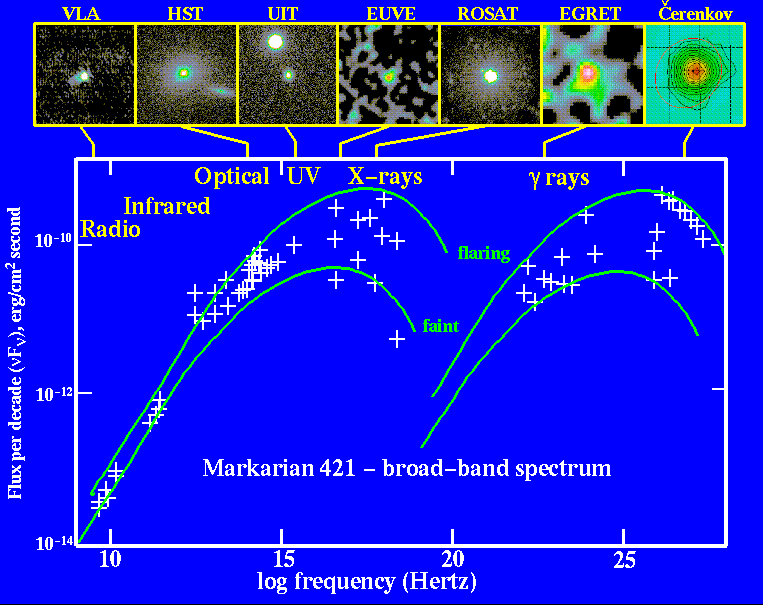
Modern astrophysics is characterized by its multiwavelength (MW) approach to studies of various kinds of objects. Putting together data coming from gamma, X-ray, UV, optical range, IR, sub-mm, and radio gives the possibility of a complete unbiased study of an object, both galactic and extragalactic one. For this, ground-based and space telescopes are being used providing full coverage of the sky in various wavelength bands, as well as spectroscopic coverage of optical and IR domains. MW studies are particularly important for active galaxies, both AGN and Starbursts (SB), as these objects have significant contribution in almost all wavelength ranges, from gamma to radio. It has been proved that active galaxies are among the most powerful sources in almost all wavelength ranges. Many all-sky or large area surveys have been and are being carried out to reveal new active galaxies and their new properties.
 |
AGN surveys are the source for the most interesting objects in the extragalactic Universe: QSOs, Seyfert galaxies, blazars, radio galaxies, LINERs, etc. B.E. Markarian was the first to conduct a systematic survey for active galaxies in 1965, the First Byurakan Survey (FBS), where 1500 UV-excess galaxies were revealed leading to discovery of many new AGN and SB, and in fact the definition of SB. Several dozen well-known surveys, principally at UV, optical, and radio wavelengths, have been conducted over the years and revealed dozens of thousands of AGN, while recently, new surveys in the FIR/sub-mm and at gamma/X-Ray wavelengths (INTEGRAL, Fermi, HESS, MAGIC, VERITAS, ROSAT, ASCA, |
| BeppoSAX, Chandra, XMM, SST, AKARI, SCUBA, Herschel, and Planck) have discovered a substantial new population of obscured AGN that appear to reside both in otherwise normal galaxies as well as in faint, heavily reddened hosts. New important data provide and will still provide also GALEX in the UV, SDSS in the optical wavelengths, 2MASS and WISE in NIR/MIR, and ALMA in mm. The matching of these surveys leads to the discovery of large amount of new AGNs. | |
One of the most important problems still to be solved is the study of evolutionary and physical connections between different types of objects, which will be possible by accumulating data by MW observations and their overall analysis. We appear to be entering into a golden age for AGN research. MW datasets are raising challenging new questions about the origin and evolution of AGN and their relationship to galaxy and star formation. Some of the most important current problems in AGN research are: (1) understanding the possible evolutionary and/or physical connection between the different classes of AGN: i.e. their consistency with the unification model, (2) the relation of AGN to their host galaxies, (3) understanding the true fraction of heavily obscured AGN in order to determine the true AGN luminosity function and its variation with redshift. Other questions could be: What do we learn about dusty tori from these MW samples? How does the evolution of source counts relate to galaxy evolution and galaxy interaction rate? What is the relationship of the inferred population of supermassive black holes (SMBH) from AGN to the observed local population of BH's surveyed by stellar and gas disk kinematics? How accurately does the high-redshift end of the quasar distribution reflect the actual formation of AGN, and how does that formation history compare to that of galaxies? How obscured are AGN in the early Universe? A major advance in these analyses should come from a cross-correlation of data from the different MW surveys plus the timely planning of future follow-up studies. Our proposed Symposium will be important for addressing all of these questions and objectives.
On the other hand, modern astronomy enters the era of Virtual Observatories (VO), an environment, where available databases and current observing material are being used as a collection of interoperating data archives and software tools to form a research environment in which complex research programs can be conducted. To make progress in the field of AGN, building “complete” samples at various wavelengths is certainly necessary. Digitization of the existing important photographic surveys, integration of these data into the format of the current digital surveys such as the SDSS, as well as present and future digital surveys are and will be important contributions to this undertaking. Among all these data, a large spectroscopic database for all objects would be especially useful; the Digitized First Byurakan Survey (DFBS) now provides 20,000,000 low-dispersion spectra of all objects over 17,000 square degrees surface of the Northern extragalactic sky. The Symposium would provide a good opportunity to elaborate a strategy, based on the acquired experience, to plan future surveys best fitted to fulfill the needs, and to coordinate follow-up observations with the new large ground-based and space telescopes. Although large telescopes will be needed for the most distant sources, the brighter objects could still be studied by targeted surveys with relatively smaller telescopes.
| The timing of an IAU Symposium in October 2013 will be perfect to take advantage of the interest that will be strong among the AGN community in gathering together existing survey data on AGN as well as in planning for new surveys during the lifetime of the present and near-future space missions. Of particular interest are the number of recent important observations made in gamma/X-rays, and in the FIR and sub-mm. We have succeeded in resolving the hard X-ray background into discrete sources and revealing many new AGN at a wide range of redshifts. A substantial fraction of these sources appear to be highly obscured and certainly deserved to be observed at many wavelengths to understand their properties. At FIR/sub-mm/mm wavelengths we have succeeded in resolving a substantial fraction of the FIR/sub-mm/mm background into discrete sources, and although many of these may be SB galaxies, a majority of the most luminous sources appeared to be powered by AGN. | 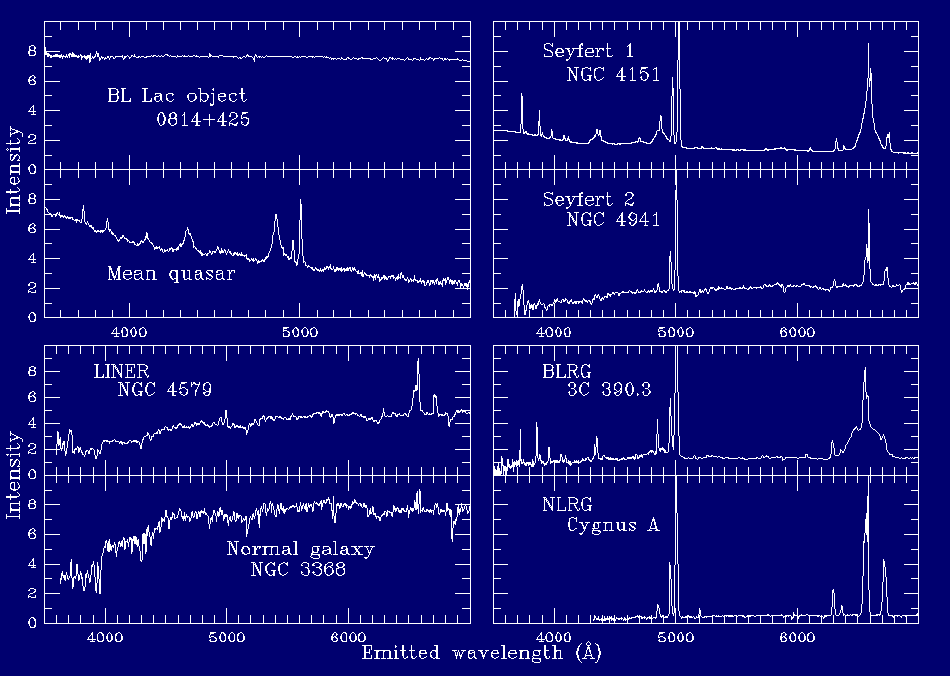 |
| There will clearly be great interest in obtaining as much MW data as possible (radio-through-UV) in order to understand the properties of the X-ray and FIR sources and their relation to optical and radio selected objects. | |
The proposed Symposium will bring together survey specialists who can exchange acquired experience, compare different surveys, discuss methodological problems, and elaborate a strategy for further investigations. It would be helpful for planning the most efficient way to make significant advances in the field: plan future surveys best fitted to improve our knowledge about AGNs, coordinate observations with large ground-based and space telescopes, construct as homogeneous as possible sample of AGNs over the whole sky, obtain an overall patterns of the distant Universe and understand AGN phenomena and the related evolution of galaxies. The Symposium will be important for addressing all of above mentioned questions and objectives.