
RA MESCS Higher Education and Science Committee Advanced Research Grant 21AG-1C044 (2021-2026)
Star Forming Regions: Origin and Evolution
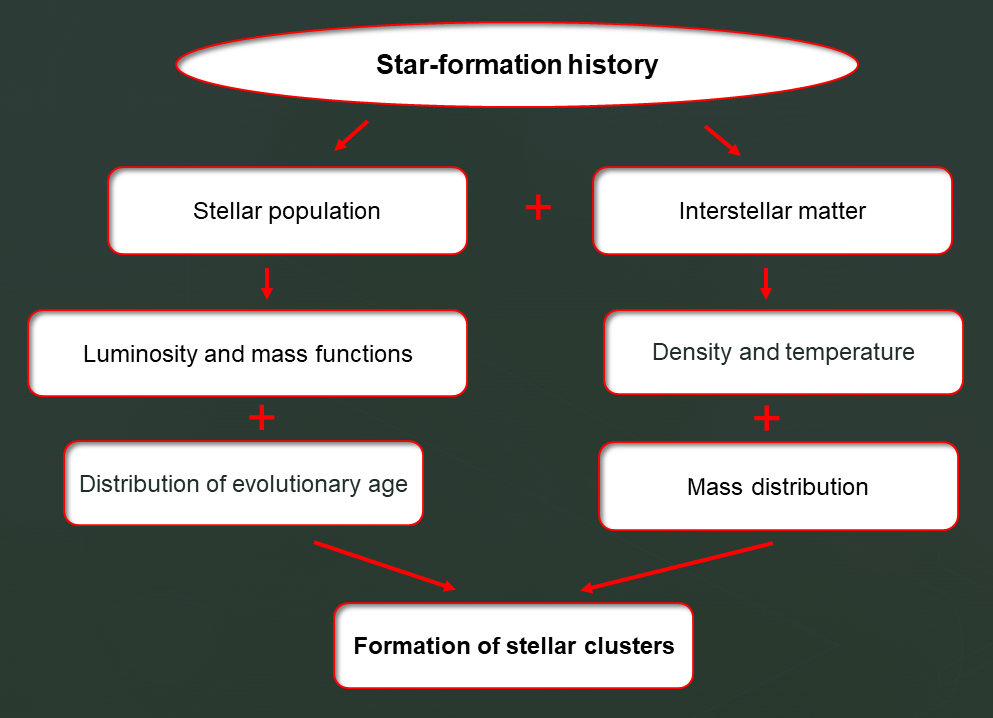
Presently, in the theory of star formation there are more questions than answers. However, there is no doubt that high mass stars play a key role in this process. The main goal of this project is a comprehensive investigation of the star-forming regions, which includes the study of two main and genetically related components: stellar content and interstellar medium. For this purpose, three extended star-forming regions have been selected: GRSMC 45.46+0.05, the "Arclike" molecular cloud, and G345.5+1.5. All regions have a complex hierarchical structure, containing a large number of high-mass stars at different stages of evolution, and therefore the star formation process in them is assumed to be multi-stage or sequential. Ultimately, based on data from the interstellar medium, stellar groups composition, and putative triggers of star formation, we will be able to reconstruct and model the history of star formation in the regions. From our point of view, comparing the obtained data with other star-forming regions, analysis of common patterns and differences will contribute greatly to solving one of the fundamental problems of modern astrophysics, namely the theory of star formation.
Research Team










Research program
Results
GRSMC 45.46+0.05 molecular cloud
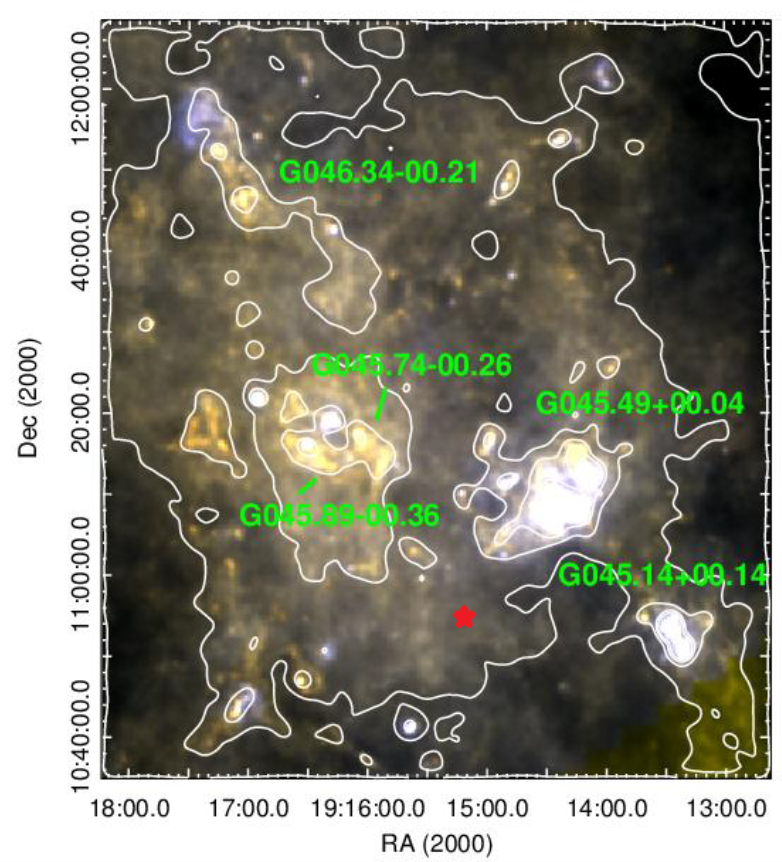
Study the young stellar objects (YSOs) inside the G045.14+00.14 and G045.49+00.04 molecular clouds reveals young stellar clusters in the vicinity of IRAS sources. Each cluster includes several high-mass stars. Most members of these clusters are concentrated around the ZAMS and show a well-defined peak at an age of Log(Age[years]) ≈ 6.75, with a narrow spread. Both regions are located and distinguished by their brightness and density at the edge of the bubble around the highly variable X-ray binary GRS 1915+10 (red star), which includes a black hole and a K-giant companion. Based on the above, it can be assumed that the process of star formation in the young IRAS clusters was triggered by the GRS 1915+10-initiated bow shock inside the ISM massive condensation, through the process of «collecting and collapse».
"Arclike" molecular cloud
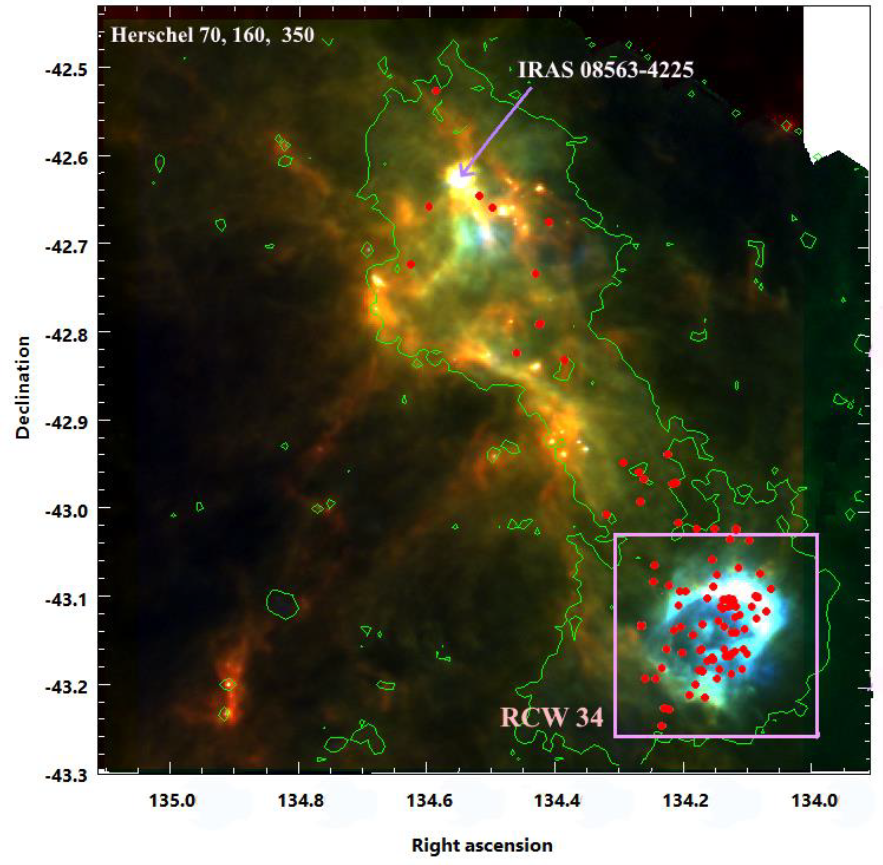
We have identified 13 runaway/walkaway stars with observed bow shocks in Vel OB1. Among these stars, four are mentioned for the first time in this study. We were able to find the parent cluster for 11 of these stars. The correlation between kinematic ages of these 11 stars and the evolutionary ages of their parent stellar clusters suggests that they left their birthplace as a result of the dynamical ejection shortly after cluster formation. The constructed path of runaway Vela X-1 HMXB over 5 Myr suggests that this binary system was kicked out from the Vel OB1 more than 2 Myr ago. Comparison of the path of Vela X-1 HMXB and structure of "Arclike" molecular cloud, which houses the RCW34 HII region, over 5 Myr leads us to propose that the 'Arclike' structure was formed by a shock wave resulting from a supernova explosion about 2-2.5 Myr ago.
New eruptive variable
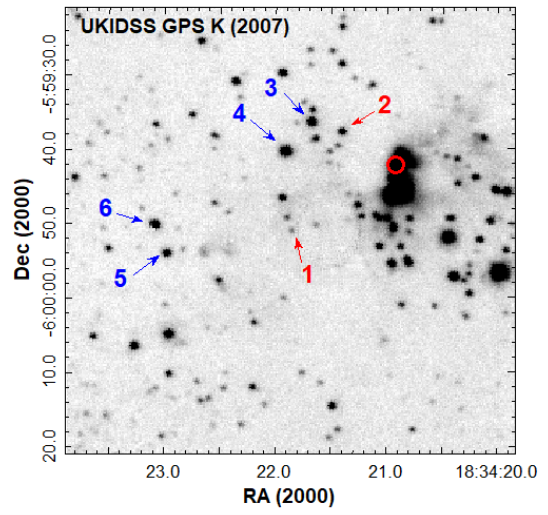
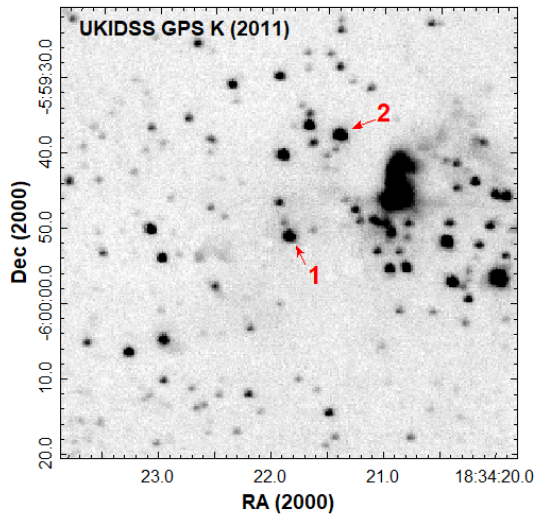
Eruptions of YSOs are rare events; therefore, a new outburst is always noteworthy. There are two new high-amplitude variable YSOs, J183421.85-055951.0 (#1) and J183421.39-055937.7 (#2), located in the RAFGL 7009S star-forming region. The color indices indicate that these objects have an early evolutionary stage.
IRAS 05168+3634 star-forming region
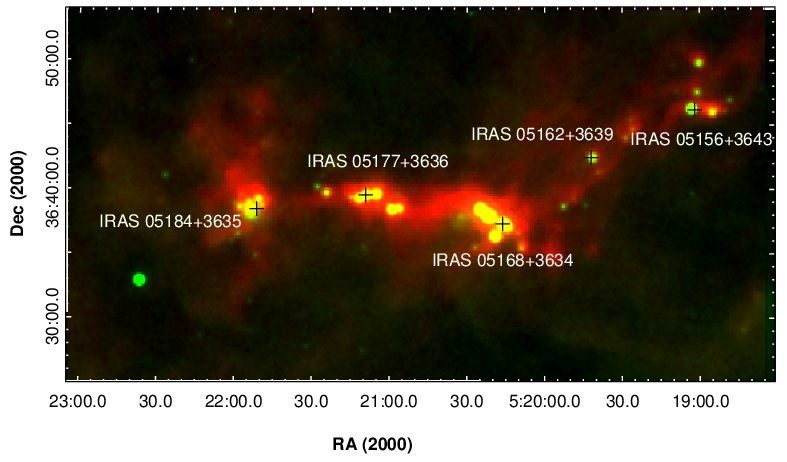
We provide a comparative analysis of the properties of the Interstellar medium (ISM) and YSOs in the extended star-forming region that hosts several IRAS sources. The wide spread of YSOs' evolutionary ages across all sub-regions (from 105 to 107 years) suggests that the process of star formation in the considered region occurs sequentially. Sub-regions characterized by higher ISM density and mass exhibit a higher percentage of YSOs with the Class I evolutionary stage, indicating more active ongoing star formation.
Publications
|
|
Awards:
Supervision of graduation work for the Bachelor of Physics degree
|
|